Reginald
The Reincarnationist PapersReginald, an English prisoner in a Tunisian desert prison, becomes Evan Michaels’s first companion there and, near the end of his sentence, the person entrusted with Evan’s three notebooks. His conversation moves between jokes, practical rules for surviving confinement, and anxiety about a wife and child cut off from him. That combination makes him more than a fellow inmate: he offers Evan immediate human company while revealing what prolonged isolation can make a prisoner fear and hope for.
Identity and Introduction
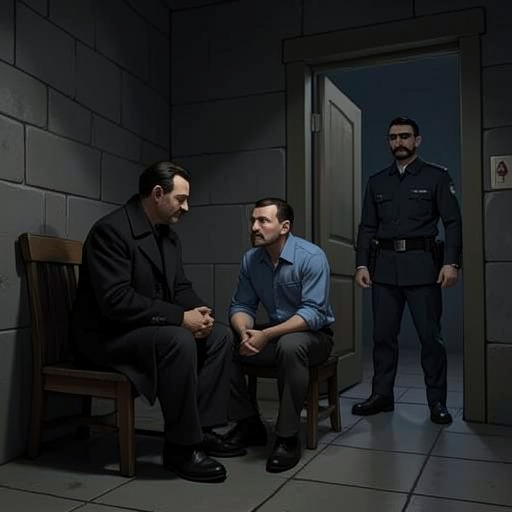
Reginald enters the story as the sole other prisoner in Evan’s small cell. The guards leave Evan there, and Reginald introduces himself in a Cockney accent. His first remarks turn the authorities’ treatment of foreign prisoners into a bitter joke: the prisoners are treated as though they were the savages. The humor is also an opening gesture, an attempt to make contact with a stranger who has just arrived.
Reginald’s welcome is practical before it is intimate. He finds a wet rag made from what remains of one of his sleeves and uses it to clean Evan, whose face has been bloodied. He explains that he is glad to have another person in the cell, even if he had previously valued the extra space. For seventeen months he has been alone there. Chalk marks above his bunk record the passage of time, while his account of the silence makes clear why even a badly injured stranger is cause for relief.
His manner is expansive and self-conscious. He talks at length, then acknowledges his tendency to ramble, remembering that the Dutch prisoner Steen had said the same of him. Steen died of dysentery, and Reginald says he contracted it too and lost considerable weight. His story of the previous cellmate gives his jokes a sharper edge: conversation is welcome not because prison has become tolerable, but because isolation and illness have made ordinary company precious.
Life in the Prison
Reginald describes the prison through a mix of grim humor and useful instruction. Foreign prisoners receive two hours in the yard, but at the hottest part of the day; they are not made to work, though mistreatment is part of their routine. He advises Evan not to fight back. The advice is presented as hard-earned knowledge about how to endure the place, not as a claim that its rules are just.
He also explains the cell’s small survival practices. The chamber pot must not be used until night or early morning, since the prisoners depend on the water and cannot afford to contaminate it. When thirst comes, Reginald recommends drinking through a rag as the safer option. These details show how confinement reduces daily life to managing shared resources and anticipating the consequences of small decisions. Reginald’s guidance is one of the first forms of care available to Evan inside the cell.
Reginald has been sentenced to three and a half years for possessing hashish and pornography, which the judge treated as violations of Islamic law. In their early conversation he estimates that eight months remain and imagines returning to England to voice his anger at the judge’s ruling. Later, as his release approaches, the remaining time has narrowed to two days. His jokes about freedom and his steady tallying of time belong to the same effort: to picture an outside beyond the prison’s daily routine.
Family and Isolation
The prison’s separation from the outside world weighs on Reginald more heavily than the uselessness of its official provisions. A Red Crescent package arrives every six months with an English-language Koran, a skullcap, blank notebooks, and pens. He dismisses the writing materials because there is no mail system: prisoners cannot send letters or receive replies. A notebook can hold words, but there is no channel by which those words can reach the people who matter to him.
Reginald says that he left a wife and a four-year-old son in the West End; he briefly begins to call the boy one before correcting himself. They know nothing of his imprisonment, and he fears they may think him dead. He worries that his wife may have moved on and that another man may be raising his son in his place. The account is not simply homesickness: it is the uncertainty of being unable to know whether family life has continued without him, or how he will fit into it if he returns.
That confession resonates with Evan’s own isolation. Evan realizes that no one outside knows where he is, and that the favor he had hoped Ramsay might provide cannot reach him. He has been denied communication and representation until arriving in Tunisia, too late for that assistance to change his situation. Reginald’s openness thus gives form to a fear Evan recognizes, even as Evan remains unable to disclose everything about himself.
The Notebooks and Reginald’s Role
Reginald’s care for Evan continues after their first meeting. When Evan does not feel ready to talk, Reginald accepts the silence, tends to him, and keeps him company without demanding a response. He also asks whether he still looks well. Evan understands that Reginald has had no access to a mirror and that the question carries a need for reassurance; he nods, and Reginald returns to his talk. In this brief exchange, companionship consists not of full understanding but of noticing what the other person needs and answering as gently as possible.
Near his release, Reginald agrees to take Evan’s three notebooks with him. Evan considers asking him to contact Ramsay, but the secrecy oath he has adopted prevents him from revealing the truth about the Cognomina. He has written the notebooks in Bulgarian so Reginald will not understand their contents. The arrangement is therefore both an act of trust and a deliberate limit on trust: Reginald will carry the record, but he is not told what it means.
Evan asks him to keep the notebooks for a stranger who might come to his door in about eighteen years. Reginald is to give that person the three books and tell them about Evan if they ask. The request transforms the blank paper Reginald had once called useless into a means of carrying a message beyond the prison’s barriers. He agrees without knowing the full purpose, and becomes the human link between Evan’s present confinement and a possible future reader.
Narrative Significance
Reginald’s role joins two kinds of separation: his inability to communicate with his family and Evan’s inability to explain his own history without breaking his oath. In the cell, Reginald speaks freely because conversation has been scarce; Evan listens while withholding the secret that shapes his choices. Their exchange is unequal in what each can disclose, but it is not empty. Reginald’s care, humor, and willingness to carry the notebooks give Evan practical help and a limited connection to the world beyond the prison.
His final contribution is especially consequential because it is modest and concrete. He does not need to understand the notebooks to preserve them or pass them on. The story places their future in the hands of a man who has spent years fearing that his own family has forgotten him. Reginald’s release offers no assurance about what will happen to Evan’s message, but it gives the message a route out: three books, a stranger expected years later, and a promise to speak if asked.